Product Description
MANUFACTURER
NXP Semiconductors
PRODUCT CATEGORY
Microcontroller
DESCRIPTION
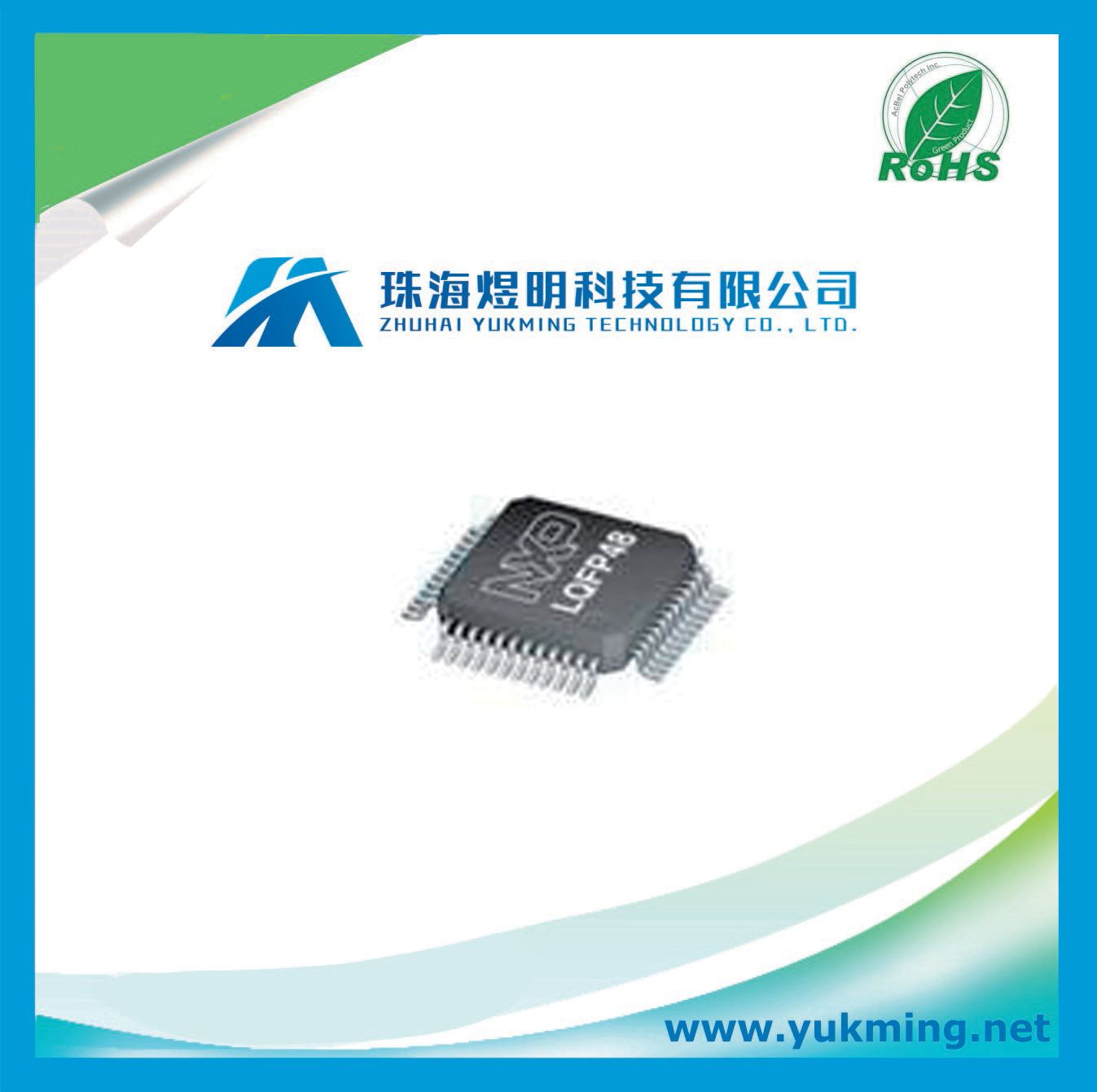
MCU 16-bit/32-bit LPC2000 ARM7TDMI-S RISC 32KB Flash 1.8V/3.3V 48-Pin LQFP Tray
Single-chip 16-bit/32-bit microcontrollers; 8 kB/16 kB/32 kB flash with ISP/IAP, fast ports and 10-bit ADC
Specifications
EU RoHS Compliant
Family Name LPC2000
Data Bus Width (bit) 16|32
Instruction Set Architecture RISC
Maximum Clock Rate (MHz) 70
Maximum CPU Frequency (MHz) 70
Device Core ARM7TDMI-S
Program Memory Type Flash
Program Memory Size 32KB
RAM Size 8KB
Number of Programmable I/Os 32
Core Architecture ARM
Programmability Yes
Number of Timers 4
Interface Type I2C/SPI/SSP/UART
CAN 0
I2C 2
SPI 1
Ethernet 0
UART 2
USART 0
USB 0
I2S 0
Maximum Operating Supply Voltage (V) 1.95|3.6
Minimum Operating Temperature (°C) -40
Maximum Operating Temperature (°C) 85
ADC Channels 8
ADC Resolution 10
Number of ADCs Single
Packaging Tray
Minimum Operating Supply Voltage (V) 1.65|2.6
Typical Operating Supply Voltage (V) 1.8|3.3
CECC Qualified No
Mounting Surface Mount
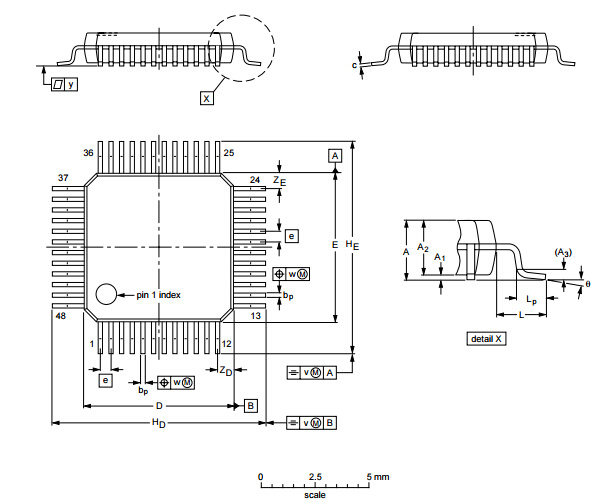
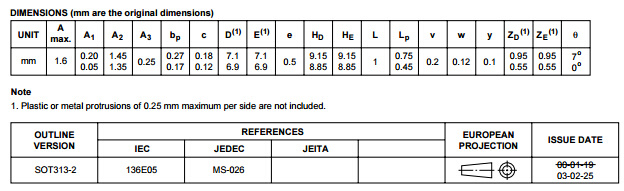
Package Height (mm) 1.45(Max)
Package Length (mm) 7.1(Max)
Package Width (mm) 7.1(Max)
PCB changed 48
Standard Package Name QFP
Supplier Package LQFP
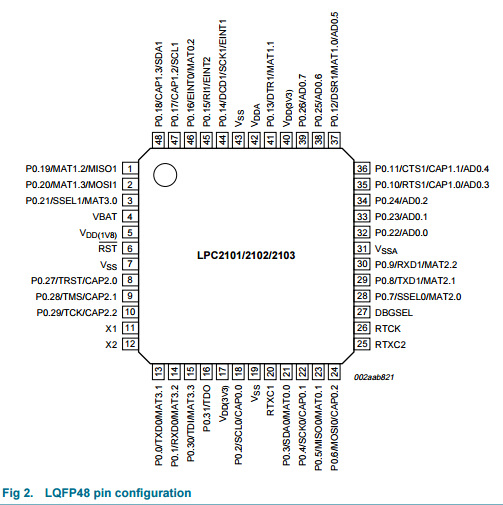
Pin Count 48
Lead Shape Gull-wing
Description
The LPC2101/2102/2103 microcontrollers are based on a 16-bit/32-bit ARM7TDMI-S
CPU with real-time emulation that combines the microcontroller with 8 kB, 16 kB or 32 kBof embedded high-speed flash memory. A 128-bit wide memory interface and a unique accelerator architecture enable 32-bit code execution at the maximum clock rate. For critical performance in interrupt service routines and DSP algorithms, this increases performance up to 30 % over Thumb mode. For critical code size applications, the alternative 16-bit Thumb mode reduces code by more than 30 % with minimal performance penalty.Due to their tiny size and low power consumption, the LPC2101/2102/2103 are ideal for applications where miniaturization is a key requirement. A blend of serial communications interfaces ranging from multiple UARTs, SPI to SSP and two I2C-buses, combined with on-chip SRAM of 2 kB/4 kB/8 kB, make these devices very well suited for communication gateways and protocol converters. The superior performance also makes these devices suitable for use as math coprocessors. Various 32-bit and 16-bit timers, an improved 10-bit ADC, PWM features through output match on all timers, and 32 fast GPIO lines with up to nine edge or level sensitive external interrupt pins make these microcontrollers particularly suitable for industrial control and medical systems.
Key features
16-bit/32-bit ARM7TDMI-S microcontroller in a tiny LQFP48 package.
2 kB/4 kB/8 kB of on-chip static RAM and 8 kB/16 kB/32 kB of on-chip flash program
memory. 128-bit wide interface/accelerator enables high-speed 70 MHz operation.
ISP/IAP via on-chip bootloader software. Single flash sector or full chip erase in
100 ms and programming of 256 bytes in 1 ms.
EmbeddedICE RT offers real-time debugging with the on-chip RealMonitor software.
The 10-bit A/D converter provides eight analog inputs, with conversion times as low as 2.44 µs per channel and dedicated result registers to minimize interrupt overhead.
Two 32-bit timers/external event counters with combined seven capture and seven
compare channels.
Two 16-bit timers/external event counters with combined three capture and seven
compare channels.
Low power Real-Time Clock (RTC) with independent power and dedicated 32 kHz
clock input.
Multiple serial interfaces including two UARTs (16C550), two Fast I2C-buses
(400 kbit/s), SPI and SSP with buffering and variable data length capabilities.
Vectored interrupt controller with configurable priorities and vector addresses.
Up to thirty-two 5 V tolerant fast general purpose I/O pins.
Up to 13 edge or level sensitive external interrupt pins available.
70 MHz maximum CPU clock available from programmable on-chip PLL with a
possible input frequency of 10 MHz to 25 MHz and a settling time of 100 µs.
On-chip integrated oscillator operates with an external crystal in the range from 1 MHz to 25 MHz.
Power saving modes include Idle mode, Power-down mode with RTC active, and
Power-down mode.
Individual enable/disable of peripheral functions as well as peripheral clock scaling for additional power optimization.
Processor wake-up from Power-down mode via external interrupt or RTC.
Zhuhai Yukming Technology Co., Ltd. is mainly engaged in R&D and marketing of car radar and camera system for blind spot, with a team made up of professional vehicle electronics experts and excellent management talents we have established good market network and service system now.
In the meantime, we can supply with original ICs and other electronic components including diodes, LEDs, capacitor, especially electrolytic capacitors, connectors, inductors, relays etc.
We take scientific and technological innovation as the forerunner, integrity management and long-term cooperation as development criterion, build credibility with quality to serve the global CM, OEM, ODM and EMS, this is our consistent pursuit.
All of you are welcomed to visit us and give instructions, so that we can develop and make the progress hand in hand.
Following "Quality First, Service Oriented", Yukming is here for you!