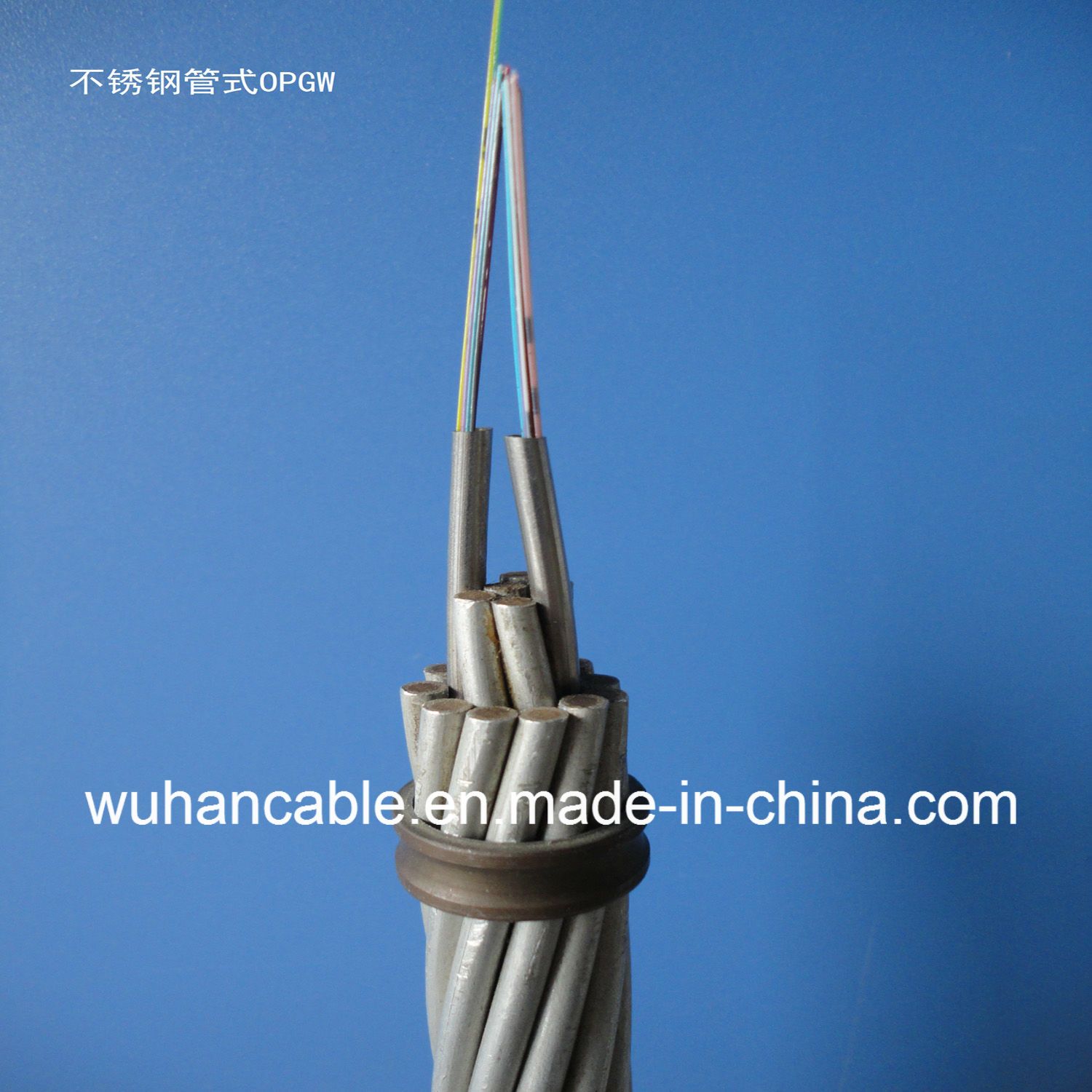
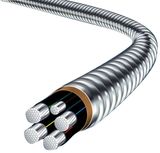
Opgw ADSS Oppc Optical Fiber Cable
| Price: |
US $ 0.01-100/Meter |
| Min Order: |
1000/Meter |
| Pay Type: |
L/C,T/T,D/P,Western Union,Paypal |
| Prod Model: |
OPGW |
| Application: |
Communication |
| Type: |
Single-mode Fiber |
| Certification: |
CCC |
| Sheath Material: |
None |
Product Description
OPGW ADSS OPPC optical fiber cableBecause of the wide variety of conditions to which they are exposed, opticalfibers have to be encased in several layers of protection. The first of these layers isa thin protective coating made of ultraviolet curable acrylate (a plastic), which isapplied to the glass fiber as it is being manufactured. This thin coating providesmoisture and mechanical protection. The next layer of protection is a buffer that is typically extruded over thiscoating to further increase the strength of the single fibers. This buffer can beeither a loose tube or a tight tube. Most data communication cables are madeusing either one of these two constructions. A third type, the ribbon cable, is fre-quently used in telecommunications . Loose-tube (loose-buffer) cable is used mostly for long-distance applicationsand outside plant installations where low attenuation and high cable pullingstrength are required. Several fibers can be incorporated into the same tube, pro-viding a small-size, high-fiber density construction. The cost per fiber is alsolower than for tight-buffered cables. The tubes may be filled with a gel orwrapped in an absorbent tape, which prevents water from entering the cable andoffers additional protection to the fibers. Since these cables must be terminatedeither by fusion splicing to preconnectorized pigtails or by using breakout kits,they are more cost-effective for longer-distance applications than they are forshort-distance applications. The fibers are completely separated from the outsideenvironment. Therefore, the loose-tube cables can be installed with higher pullingtensions than tight-buffered cables. A tight-buffered cable design is better when cable flexibility and ease oftermination are a priority. Most inside cables are of the tight-buffered designbecause of the relatively short distances between devices and distribution racks.Military tactical ground support cables also use a tight-buffered design becauseof the high degree of flexibility required. A tight-buffered fiber can be cabled withother fibers, and then reinforced with Kevlar™, and jacketed to form a tightpack(distribution) cable. Another option is to individually reinforce each fiber withKevlar, then jacket it. Several single fiber units can then be cabled together toobtain a breakout-style cable where each fiber can be broken out of the bundleand connectorized as an individual cable. A ribbon-style cable consists of up to 12 coated fibers bonded to form a rib-bon. Several ribbons can be packed into the same cable to form an ultra-high-density, low-cost, small-size design. Over 100 fibers can be put into a 1/2-inchsquare space with ribbon cables. Ribbon fibers can be either mass fusion splicedor mass terminated into array connectors, saving up to 80 percent of the time ittakes to terminate conventional loose or tight-buffer cables. Cable Jacketing The materials used for the outer jacket of fiber optic cables not only affect themechanical and attenuation properties of the fiber, but also determine the suit-ability of the cable for different environments, and its compliance to variousNational Electric Code (NEC) and Underwriters Laboratories (UL) requirements. A cable that will be exposed to chemicals can utilize an inert fluorocarbonjacket such as Kynar, PFA, Teflon FEP, Tefzel, or Halar. These materials are suit-able for a very wide range of applications, although they may be too stiff forsome industrial applications. Aerospace applications require that the cables be able to withstand a widetemperature range and be routed through the cramped environment of an air-craft. These cables are frequently rated for continuous operation from -65°C to+200°C, are less than 1/10 inch in size, and can sustain a bend radius of 1/2 inch. Fire safety is a major issue. Cables used in an industrial environment, such asa power plant, are usually placed in horizontal trays. Several cable trays may bestacked in close proximity. In the event of a fire, both horizontal fire propagationand the ignition of lower cable trays by the dripping of flaming outer jacket ma-terial must be prevented. An irradiated Hypalon or XLPE jacket will meet the flame spread requirements (IEEE-383, 1974). When exposed to a flame, thejacket material will char rather than melt and drop burning material, thuspreventing the ignition of cables in lower trays. Inside premises cables have tomeet the requirements of the NEC Article 770. The outer jacket selection is essen-tial to ensure compliance to the flame and smoke requirements. Environmental and Mechanical Factors Aside from buffer type, jacketing system, and flammability requirements, thecable design also must be based on the mechanical and environmental conditionsthat will be encountered throughout the system's life span. A cable that will be pulled through conduits, ducts, or cable trays will have toincorporate a number of strength members and stiffening elements to add tensilestrength and to prevent sharp bends from damaging the fibers. The addition ofKevlar increases the cable tensile strength. Kevlar can either be braided or longi-tudinally applied underneath the cable or fiber component jackets. The centralstrength member also serves both as a filler around which the fiber componentsare cabled and as a strength member when it incorporates steel, Kevlar, or epoxyglass rods. Another function of the epoxy glass central member is to act as anantibuckling component, counteracting the shrinkage of the jacketing elements atlow temperatures and preventing microbends in the fibers. An epoxy glass rodcentral member should always be used in cables that may be exposed to tempera-tures below 0°C.
Aerospace Electric Group Co., Ltd (AEG for short), formerly known as Wuhan Cable Group Co., Ltd., is an state-owned enterprise subsidiary to the 9th Research Institute of China Aerospace Science and Technology Corporation (CASC). Specialized in manufacturing and R&D of excellent quality electric wires & cables with over 60 years' professional experience, AEG now integrates Conductor Business Division, Power Cable Business Division, International trade Division, Aerospace Rich Special Cable Co., Ltd, Hubei Aerospace Cable Co., Ltd and Hubei Longsky Communication Technology Co., Ltd. Now AEG has 2080 employees, including 300 senior professionals. The total asset of the group has reached 3.85billion RMB.
AEG imports a series of advanced production and testing equipment from Germany, the United States, Britain, Italy, etc., which helps to achieve the production capability of 30, 000 tons of aluminum alloy conductors, 80, 000 tons of aluminum conductor steel-reinforced(ACSR), 24, 000 tons of aluminum-clad steel wires, 30, 000 km. Of LV and MV cables and 50, 000 km. Of special cables and wires. The overall production scale reaches 5 billion RMB.
Products of AEG are applicable to power production, power supply, construction and installation etc., We supplied for Daya Bay Nuclear Power Plant, Three Gorges Hydroelectric Power Station, Datang Power Plant, Wuhan Tianhe International Airport, Guangzhou---Wuhan Express Railway, Daqing Oil Field, Tiananmen Square reconstruction, Wuhan Metro, etc. The military-related products are used by Xichang Satellite Base, Chengdu Airport, the 2ND Artillery Corps, Dongfeng Motor, Naval Base and other large scale nationally focused engineering construction. They are also exported to more than 20 countries and regions including USA, Germany, Greece and Pakistan. Many products are granted with national, ministerial, provincial and municipal Excellent New Product Award and Prize for Progress in Science and Technology while others obtain national utility model patents.
We're pleased to get your Inquiry and we will come back to as soon as possible. We stick to the principle of "quality first, service first, continuous improvement and innovation to meet the customers" for the management and "zero defect, zero complaints" as the quality objective.
More >
Other Products with This Manufacturers